
Seven Things Organisations Getting AI Governance Wrong Are Doing Identically.
-> what failed, why it failed identically across sectors, and the specific corrective action that distinguishes organisations that recovered from those that compounded the problem

TL;DR
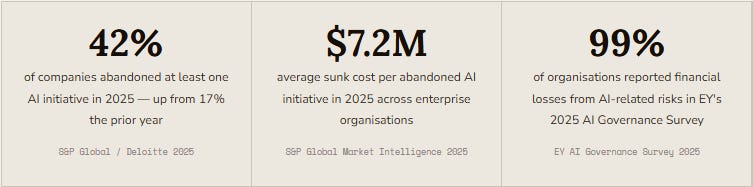
42% of companies abandoned at least one AI initiative in 2025, with an average sunk cost of $7.2 million per abandoned initiative. The technology was not the problem. In every documented failure pattern, the model did what it was built to do. What failed was the governance architecture surrounding it — the oversight that was drafted but not operationalised, the inventory built once and never updated, the board policy adopted and never tested. This brief names the seven field patterns that appear with near-identical frequency across sectors. The free tier names all seven patterns and their consequences. The paid tier delivers the complete corrective protocol — specific, sequenced, and executable — for each.

What the 42% Left Behind
The statistics from 2025 and 2026 are strikingly consistent. S&P Global Market Intelligence: 42% of companies abandoned at least one AI initiative in 2025, up from 17% the year before. Average sunk cost per abandoned initiative: $7.2 million. ISACA's analysis of the top AI incidents from 2025 reached an unambiguous conclusion: the biggest failures were not technical. They were organisational — weak controls, unclear ownership, and misplaced trust in documentation that described functioning governance without producing it.
EY's 2025 AI Governance Survey found that 99% of organisations reported financial losses from AI-related risks. Average loss: $4.4 million per company. These were not organisations with no governance. They were organisations with governance on paper — and the paper was not the governance.
The most dangerous AI governance failure in 2025 was not the organisation that built nothing. It was the organisation that built everything on paper — policy, framework, board resolution, inventory — and then treated the documentation as the deliverable rather than the documentation of the deliverable.
What Organisations Getting AI Governance Wrong Are Doing Identically
The seven patterns below are presented in the order they typically compound. Pattern 1 creates conditions for Pattern 2. Patterns 3 and 4 accelerate together. Patterns 5, 6, and 7 are late-stage manifestations of the earlier failures.
Governance Architecture Pattern
P1: The Inventory That Was Built Once and Never Updated.
Finding: The AI inventory — foundational document required by every framework in the regulatory stack — is built at the beginning of a governance program and treated as a completed deliverable. New AI tools are adopted without triggering an inventory update. Shadow AI expands from margin to mainstream. By the time a regulatory audit, insurance renewal, or Caremark board review arrives, the inventory describes an AI landscape that no longer exists.
Consequence: Every subsequent governance deliverable — risk assessment, quarterly board AI risk report, ISO 42001 Annex A controls — is built on a description of AI deployment that no longer matches operational reality. An outdated inventory produces discoverable inconsistency between asserted and actual governance.
The Fix: The AI inventory must be a living document with a defined update cadence and a clear deployment trigger. Every new AI tool adoption triggers an inventory update before deployment. Quarterly shadow AI discovery audits conducted on a formal governance cycle. Named inventory owner with explicit accountability.
Oversight Architecture Pattern
P2: The Human Oversight Protocol That Existed in Policy and Nowhere Else.
Finding: The Output Accountability Architecture is documented and implemented formally. Then operational pressure increases AI output volume while time for review decreases. The sign-off process is streamlined informally. Within six months, the protocol exists in the policy document and in records from its first month of operation. Subsequent months have no sign-off records at all.
Consequence: ISO 42001 Stage 2 auditors request a sample of recent sign-off records. The sample window is the last 90 days. The organisation has 90-day-old records and then nothing. The policy becomes evidence of an oversight commitment that was not sustained. ABA professional responsibility framework finds no verification records for recent AI-assisted legal work product.
The Fix: Embed the sign-off protocol into the operational workflow — the verification record must be generated as a by-product of the work, not as a separate compliance step. Monthly completion rate metric. When sign-off rates fall below 90%, treat it as a governance incident.
